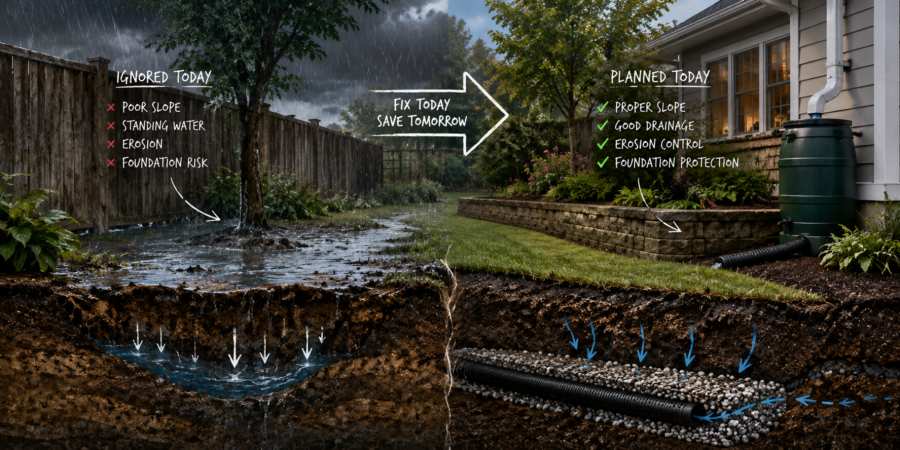
Drainage problems rarely announce themselves with dramatic sound effects or flashing warning signs. More often, they creep into a property through small clues that are easy to dismiss. A puddle that lingers after rain. A corner of lawn that feels soft enough to swallow a garden shoe. Mulch that wanders away after every storm as though pursuing independence.
Poor drainage is not simply an inconvenience reserved for people who enjoy discussing soil over coffee. Water that moves badly through a yard can lead to erosion, damaged landscaping, weakened hard surfaces, and in more serious cases, trouble near a home’s foundation.
Early Warnings Most People Ignore
Some drainage problems begin with signs so subtle they barely register.Persistent soggy patches are among the most common indicators. If one area of the lawn stays damp long after the rest of the yard dries, water may be pooling below the surface or struggling to escape. Grass in these spots often looks thinner or develops uneven color because roots are receiving more moisture than they can comfortably manage.
Another overlooked clue appears along fences, pathways, or garden edging. Soil may slowly wash away during rainfall, exposing roots or creating shallow channels. Many homeowners assume this is normal settling, but repeated soil movement usually points toward water following an unhealthy path.
Take a careful look at hard surfaces as well. Patios and walkways can reveal drainage trouble long before major damage develops. Small shifts, cracks, or uneven sections may signal that water is eroding supporting soil underneath. That slightly tilted paver might not be expressing artistic ambition.
Water stains or damp areas near exterior walls deserve serious attention. When runoff repeatedly gathers close to a structure, moisture can place pressure on foundations and encourage costly problems over time.
Why Water Chooses Certain Paths
Water behaves with stubborn logic. It follows gravity, seeks the easiest route, and shows little concern for landscaping plans sketched with optimism on a Saturday afternoon.The shape and slope of a yard play a major role in determining where rainfall travels. Even slight elevation changes can direct runoff toward vulnerable areas or trap it where drainage is poor.
A yard that appears mostly level is not always functioning properly. In fact, overly flat spaces can struggle because water lacks enough gradient to move away efficiently. Instead of flowing outward, it collects and lingers, slowly turning sections of lawn into reluctant wetlands.
Sloped yards present a different challenge. When grading is too steep or poorly managed, runoff gains speed and force. Instead of soaking gently into the ground, water races downhill carrying soil, mulch, and sometimes carefully arranged landscaping with the determination of a shopping cart on a slope.
Understanding how water moves across a property is essential before making upgrades or planting decisions. A beautiful landscape can struggle if the invisible mechanics underneath are ignored.
Retaining Structures and the Water Question
Retaining walls and similar structures often receive attention for their appearance, yet their practical role is just as important.These structures help manage elevation changes and hold soil in place, but they also influence drainage patterns. A retaining wall that lacks proper drainage behind it can become a problem rather than a solution.
Water naturally builds pressure when trapped. Behind retaining structures, this pressure can increase significantly after heavy rain. Over time, trapped moisture may weaken the wall, cause leaning, or contribute to cracking and shifting.
Proper drainage systems behind retaining walls usually include gravel backfill, drainage pipe, and carefully planned outlets that guide water away safely. This is not glamorous work, and no one posts celebratory photos of correctly installed drainage rock, yet it often determines whether a wall remains stable for years.
The same principle applies to raised garden beds, edging systems, and terraced landscapes. Every feature added to a yard influences water movement in some way.
Practical Ways to Stay Ahead of Trouble
Preventing drainage problems usually costs less and creates less frustration than repairing damage later.A few practical steps can make a noticeable difference:
- Monitor puddles after rainfall and note where water lingers.
- Keep gutters and downspouts functioning properly and direct discharge away from foundations.
- Inspect slopes and planting areas for erosion or exposed roots.
- Avoid adding hard surfaces without considering how runoff will be redirected.
- Assess retaining walls and elevated areas for signs of trapped moisture or movement.
Serious drainage concerns should never be dismissed as cosmetic annoyances. Water that repeatedly gathers near a structure or causes visible erosion deserves prompt evaluation. Delays often allow minor problems to become expensive repairs hidden beneath soil and landscaping.
Making a Splash for the Right Reasons
A healthy backyard is not simply attractive on sunny afternoons. It performs well when conditions become difficult. Good drainage works quietly in the background, directing water where it belongs and helping landscapes remain stable, usable, and easier to maintain.Most homeowners notice drainage only when something has already gone wrong. By paying attention to subtle warning signs and understanding how slopes and retaining structures shape water movement, it becomes possible to prevent soggy lawns, erosion, and foundation headaches before they settle in for a long stay. Water will always travel somewhere. The goal is making sure it does not choose your backyard as its permanent mailing address.
Article kindly provided by kairoslandscapes.com