Smooth Operators and the Allure of Control
Polished concrete sends a message of composure. It’s the surface equivalent of a crisp white shirt — clean, efficient, slightly intimidating if over-pressed. Guests feel they should tread carefully, perhaps remove their shoes, maybe even apologise for bringing the car. The texture says: we value order here; chaos is parked elsewhere.Yet smoothness has its downside. Without any grit or variance, it can seem a little clinical — the kind of driveway that might have a corporate mission statement. For those who enjoy their world symmetrical and their lawns exact to the millimetre, smooth concrete is therapy. For everyone else, it’s an anxiety test in poured form.
Adding a brushed finish or light aggregate texture softens the effect, introducing humanity without losing modernity. The result? You appear stylish, but approachable. A homeowner who alphabetises their pantry but also owns mismatched mugs.
Cobblestones and the Drama of History
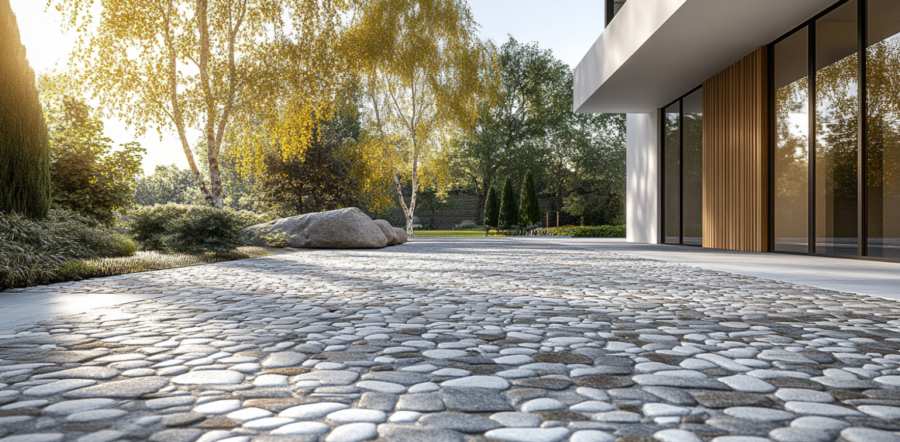
Cobblestones appeal to those who secretly believe their home should have an ancestral ghost. They are the paving equivalent of a gravelly-voiced narrator: textured, unpredictable, and unapologetically nostalgic. Each stone seems to have survived a small war. They shift underfoot, ensuring that every visitor experiences a brief flash of mortality before reaching the front door.There’s charm in that. Cobblestones produce sound — a satisfying crunch that feels alive, especially under rain. They don’t shout wealth; they murmur heritage. But they do demand commitment. Shoes wear faster, weeds make cameo appearances, and sweeping becomes a Sisyphean act. Still, for those who equate “authenticity” with minor inconvenience, cobbles are pure romance.
The mood they project is grounded warmth — something old-world and slightly aristocratic, but not in an obnoxious way. It’s the texture of time itself, curated into pattern.
Resin and the Promise of Effortless Ease
Porous resin driveways are the new aspirational texture: practical, seamless, and conveniently smug. They drain well, resist staining, and seem permanently photogenic. Standing on one feels like stepping onto the future — a future where mud is theoretical and maintenance is someone else’s problem.But the psychology is fascinating. The resin finish offers both control and flexibility. It’s warm, a little yielding, and it gives the subconscious sense of comfort — no sharp edges, no loose stones, no surprises. For contemporary homes, that matters. It’s modern optimism poured into a surface.
Color choice, however, is crucial. A pale resin surface can evoke calm Scandinavian minimalism or the atmosphere of a dentist’s waiting room, depending on lighting and landscaping. Earthy hues, by contrast, suggest stability and natural confidence. There’s quiet assurance in a driveway that looks like it belongs to the soil rather than sitting on top of it like a prop.
When Texture Meets Architecture
The harmony between surface and structure determines whether a home feels cohesive or schizophrenic. A Georgian façade paired with industrial concrete is architectural whiplash; likewise, rustic cobbles clashing with glass-and-steel minimalism feels like a period drama gatecrashing a tech conference.Choose texture that extends your building’s tone. Smooth surfaces accentuate linear, contemporary designs; rougher materials embrace homes with asymmetry and visible age. There’s no moral hierarchy — just aesthetic honesty. A mismatched texture always betrays insecurity, as if the house is pretending to be something it’s not.
Texture as a Silent Communicator
The moment a tyre or heel hits your driveway, a message is sent. Texture operates like body language — subtle but decisive. Rough surfaces convey tradition and strength; smooth ones imply efficiency and restraint. It’s the handshake before the handshake.The psychology goes deeper than taste. We respond physically to texture. Coarse surfaces slow our pace and make us feel grounded; smoother ones encourage a brisk, almost businesslike stride. Even sound plays its part: the click of shoes on pavers suggests prosperity, while the crunch of gravel announces a kind of rustic self-assurance. Each material is, in effect, a personality test you’ve laid flat on the ground.
Color, Tone, and the Illusion of Mood
Color interacts with texture to produce emotion. A grey resin surface paired with a matte finish feels urban and composed — the spiritual cousin of brushed steel kitchens and espresso machines that hiss like dragons. By contrast, warm-toned gravel or golden sandstone gives an almost Mediterranean sense of welcome. It lowers the shoulders, metaphorically speaking.The trick is in restraint. Too polished, and the driveway risks emotional sterility; too rustic, and it begins to look like an abandoned abbey. The most inviting textures balance tactile variation with tonal calm. Your subconscious should feel both stimulated and safe — like shaking hands with someone who knows your name but doesn’t remember where from.
Practical Alchemy for Every Mood
Once you understand what textures say, you can use them deliberately. Want to project prosperity without ostentation? Try resin-bonded gravel — smooth to the eye, granular to the touch. It looks as if it costs a fortune while quietly being affordable. Need to tone down a modern façade that risks looking like a tech company HQ? Introduce mixed paving zones with stone or slate edging — they lend narrative and warmth.- For a calm, orderly feel: polished or honed concrete in light grey tones.
- For warmth and tactility: sandstone or cobbles, irregular enough to feel human.
- For a balance of modern and organic: resin-bound surfaces with subtle speckling.
- For expressive character: reclaimed brick with deliberate colour variation.
Mood by the Metre
There’s an argument that a driveway is the most honest part of a home. It’s not curated for guests or arranged for Instagram — it’s lived upon, weathered, and often ignored. Yet its surface quietly determines how we experience arrival. The right texture can make returning home feel like exhaling. The wrong one can make every evening commute feel like docking at a tax office.Every driveway is an experiment in mood architecture. Choose a surface that suits not the house you bought, but the rhythm you want to live in. A gentle crunch underfoot, a bit of unevenness, a hint of gloss or grit — these small sensory cues do more for happiness than most garden furniture catalogues ever will.
Paved Intentions
Texture, in the end, is emotional engineering. You’re not just deciding what cars drive on — you’re deciding what feelings drive in. Whether you prefer the precision of concrete or the memory of stone, the surface you choose teaches everyone, including yourself, how to feel about the space called home.And if that space makes you slow down, breathe, and feel quietly pleased before stepping inside — congratulations. Your driveway has mastered psychology without ever needing a therapist.
Article kindly provided by lgcypave.com