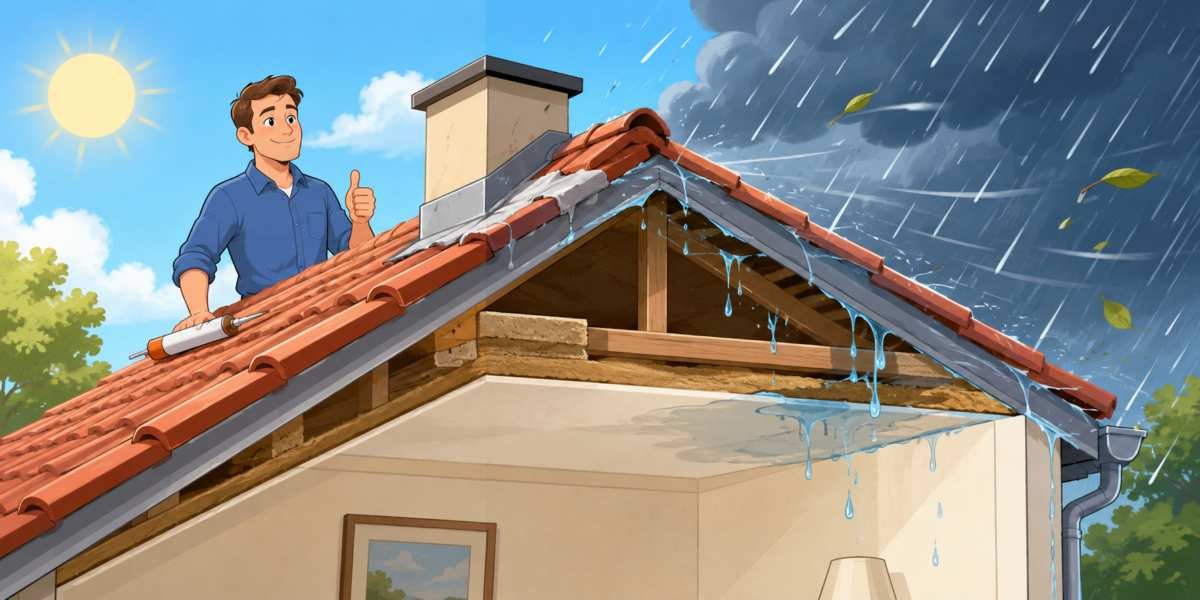
This is one of the difficulties with judging roof repairs. Dry weather proves very little, and even ordinary rainfall may not recreate the conditions that caused the original leak. A repair can therefore look completely successful while the underlying weakness remains patiently in place.
Why Ordinary Rain Can Give False Confidence
Water does not always enter a roof directly above the place where it eventually becomes visible indoors. It can travel along roofing felt, rafters, battens, pipes and other surfaces before gravity finally wins the argument. The stain on a bedroom ceiling may therefore be several feet away from the actual entry point.Light rain can make the problem even harder to identify. Water falling almost vertically may be comfortably shed by tiles and flashing that become vulnerable when strong winds push rain underneath edges, overlaps or joints. A repair tested during a gentle shower might survive perfectly. Give the same roof three hours of wind-driven rain and the result can be considerably less impressive.
Prolonged rainfall creates another challenge. Some weaknesses only become apparent once materials and surrounding areas have remained wet for hours. A tiny route for moisture may not produce enough water to become noticeable during a twenty-minute shower. During an all-night downpour, however, that tiny route has plenty of time to demonstrate its ambitions.
The Temptation to Seal Whatever Looks Suspicious
One of the simplest approaches to a leak is to find an obvious-looking gap and seal it. Sometimes that is exactly the correct repair. Unfortunately, roofs are not always considerate enough to make diagnosis that easy.Sealant applied around flashing, tiles, vents or roof penetrations can stop water temporarily without addressing why the opening developed. Flashing may have moved, a fixing may have failed, tiles may be incorrectly positioned or an underlying membrane may be damaged. Adding another generous helping of sealant can disguise the symptom while leaving the cause untouched. Eventually the sealant itself deteriorates or movement opens another route for water.
There is also such a thing as too much enthusiasm. Thick layers of roofing compound can obstruct drainage routes or trap moisture where it should be able to escape. At that point the repair begins resembling a small archaeological site, with each previous attempt preserved beneath the next one.
Finding the Cause Before Fixing the Evidence
A reliable repair begins with diagnosis. That means considering when the leak appears, which direction the weather is coming from, what lies above and around the affected area, and whether nearby roof components show signs of movement or deterioration.Homeowners should be wary of assuming that the most visible defect must automatically be responsible. Water is exceptionally good at making innocent parts of a building look guilty. Understanding its route through the roof is often more important than finding the first suspicious crack.
Questions Worth Asking Before the Repair Begins
When a repair is proposed, homeowners do not need to become amateur roofing engineers overnight. They should, however, understand what is actually being repaired and why. Asking where the water is believed to be entering, how that conclusion was reached and whether surrounding materials have been checked can reveal considerably more than simply asking how much the job will cost.It is also sensible to ask whether the proposed work is intended as a permanent repair or a temporary measure. There is nothing inherently wrong with temporary work. Emergency sealing after storm damage can prevent further water ingress until proper repairs are possible. Problems arise when a short-term patch quietly puts on a false moustache and introduces itself as a permanent solution.
Homeowners can also ask whether damaged materials will be replaced or merely sealed, whether flashing needs refixing, and whether roofing membranes, battens or nearby tiles have been inspected. Where previous repairs exist, those deserve attention too. A roof carrying several generations of sealant may be telling a longer story than the newest leak suggests.
Why the Next Storm Is the Real Test
A repaired roof should ultimately cope with the weather conditions it was designed to withstand. That includes more than straightforward rainfall. Wind can force water beneath overlapping materials, while sustained rain can expose weaknesses that remain completely invisible during shorter showers.After a significant storm, homeowners can check the previously affected internal area for fresh staining or dampness without climbing onto the roof. Loft spaces can also provide useful clues where they are safely accessible. Darkened timber, damp insulation, droplets or musty smells can indicate that water is still finding a route inside.
External inspection should generally remain at ground level. Binoculars can help identify displaced tiles, disturbed flashing or debris without turning roof maintenance into an unexpected mountaineering expedition. If there is any doubt, particularly after high winds, closer inspection is better left to someone equipped to work safely at height.
When Repeated Repairs Point Somewhere Else
A roof that repeatedly leaks in roughly the same location deserves broader investigation. Continually resealing one joint may cost less each time, but several inexpensive repairs can eventually become an expensive way of avoiding the correct one.Recurring leaks may indicate defective flashing, movement in roofing materials, damaged underlay, poor detailing around a chimney or roof penetration, blocked drainage, or deterioration extending beyond the immediately visible area. Flat roofs can present similar problems where water enters through one weakness but travels beneath the covering before appearing indoors elsewhere.
The important distinction is between repairing where water appears and repairing why water gets inside. Those two locations are not necessarily the same, and confusing them is one reason apparently successful repairs sometimes have remarkably short careers.
A Patch in Time Saves Nine Buckets
Good roof repair is less about applying the greatest possible quantity of waterproof material and more about understanding how the roof is supposed to manage water. Tiles overlap for a reason, flashing directs water for a reason, and membranes provide another layer of protection when conditions become demanding.A repair that respects those systems has a much better chance of surviving the weather that matters. Once the rain starts arriving horizontally and the gutters are working overtime, cosmetic success counts for very little.
The best repair is therefore not necessarily the one that makes the suspicious gap disappear fastest. It is the one based on a convincing explanation of what failed, why it failed and how the proposed work prevents it happening again. A dry ceiling during sunshine is pleasant, certainly, but it is hardly the roof examination that counts.
Article kindly provided by roofrepairsincarlisle.co.uk