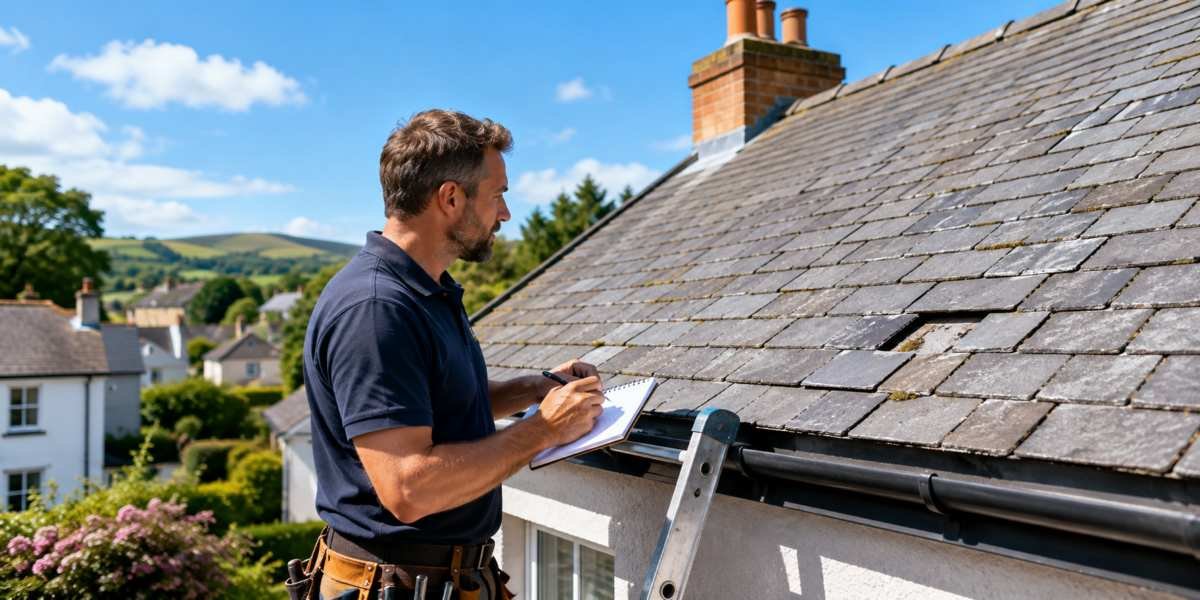
This is the point where most people either panic and agree, or panic and do nothing for two years. Both are expensive. There is a middle option, which is to spend twenty minutes working out whether the quote is right, and I want to walk you through how I would do that if it were my mother’s house.
I fit roofs for a living, so read this with the appropriate scepticism. But I make most of my money on repairs, and I have talked more people out of a new roof than into one, which colours how I see it.
Start with the size of the gap
A single repair – one slipped slate, one split flashing, one cracked bit of mortar on a chimney – is usually somewhere between £150 and £900 depending on how awkward it is to get to.A full re-roof on an ordinary terrace or semi starts around £6,000 and goes past £15,000 if you are in natural slate.
That gap is why this matters so much. Getting it wrong in one direction costs you a few hundred pounds and a wasted afternoon. Getting it wrong in the other direction costs you the price of a decent car. Nobody would spend that on a washing machine without a second opinion, and yet roofs get signed off on a handshake all the time, mostly because the homeowner has no way of judging what they have been told.
You do have a way. It just isn’t the one you think.
The question is not how old it is
Almost everyone opens with the age. My roof is sixty years old, is it done?Honestly, that tells me very little. Slate is rock. It does not wear out in any timescale that concerns you. I have worked on Victorian roofs in perfectly good order and condemned tiled roofs put on in the eighties.
What gives out is the hardware around it. Nails, mortar, lead, the battens carrying the whole lot. All of that has a working life, and it is a good deal shorter than the stone sitting on top of it.
So the useful question is not how old, but where. Specifically: when things have gone wrong, have they gone wrong in the same place, or in different places?
One spot, repeatedly, in the same weather? That is a failed detail. Some particular component has given up, whether that’s a soaker, a valley or a length of flashing, and it can be put right for a few hundred quid whatever the age of the roof.
Different spots, in different years? That is the roof telling you something else entirely.
Why it matters where the slates come off
Here is the bit that decides it, and it is the reason I will occasionally tell someone they do need to bite the bullet.Every nail in your roof went in on the same day. Same batch, same weather, same everything. They then spend decades quietly rusting at roughly the same rate. And because they started together, they finish together.
Roofers call it nail sickness. What it looks like from your garden is a slate coming off the front one winter, one off the back the next, then two more from somewhere else entirely. It feels like a run of bad luck. It isn’t. It’s several hundred fixings arriving at the end of their life within a few years of each other, and there is no repair that addresses that, because the problem is everywhere you can’t see.
If that is your pattern, the honest answer is that repairs from here are money you won’t get back. If it isn’t, be careful about anyone telling you otherwise.
Things that look alarming and mostly aren’t
A fair chunk of what frightens people into a re-roof quote is cosmetic.Moss. If you live anywhere wet – and I am in Cumbria, so I see a lot of it – a north-facing slope will go green and that is largely just what happens. Moss does not eat slate. It becomes a problem when it sheds into the gutters and valleys and blocks them, which is a gutter job, not a roof job.
One slipped slate. Slates slip. A gust catches one, a nail was always slightly proud, a bird landed badly. On its own it means nothing.
Dark staining on the loft timbers. Get up there and put your hand on it. If it is dry, that is an old leak that has already been dealt with or stopped on its own, and it can sit there looking dramatic for thirty years. Wet is a problem. Dry is history.
A roof that is simply old. Covered above, but worth repeating because it is the single most common thing used to sell a re-roof.
Things that look minor and really aren’t
The reverse is also true, and this is where I would actually worry.Sight along the ridge line from across the road. It should be dead straight. If there is a dip or a wave in it, something structural is going on underneath and that is a bigger conversation than the covering.
Grey grit in the gutter or on the drive. That is bedding mortar breaking down, usually off the ridge or off the chimney flaunching. Cheap to sort now, not cheap once water has been getting in behind it for two winters.
A flat roof that gives underfoot. Softness means the deck below has gone. Any new covering laid over that is being fitted onto something rotten, and no guarantee is worth much in that situation.
Battens that give way under a screwdriver. Slates are only ever as secure as the wood they are fixed to, and once that has gone spongy you are past the point where any fixing will hold. It is one of the few findings that turns a re-roof from eventually into now.
Four questions worth asking before you sign
You do not need to know anything about roofing to ask these. You just need to listen to how they are answered.Can you show me?
Photographs from the roof, or better, come up and look if you are able and it is safe. Anyone confident in their diagnosis is happy to show you. Vagueness here is the tell.
What has actually failed, and why?
You want a mechanism, not a material. “The lead soaker along the party wall has work-hardened and split along the fold, which is normal at that age” is a diagnosis. “It’s had it, needs doing” is not.
Is the roof coming off, or going over the top?
Fixing fresh battens and tiles straight onto what is already up there saves the fitter a day’s work and a skip. It also means nobody has laid eyes on your timbers, and your structure ends up carrying two coverings when it was only ever designed for one. If an overlay is being proposed on a house, ask why, and get the answer in writing.
Where does the lead go?
Chimneys, valleys, abutments. Lead costs real money, which makes it the easiest line to thin out when somebody is sharpening a price to win the work. A whole-roof quote that never mentions it once deserves a follow-up question.
And then get a second quote. Not because the first one is dishonest – most aren’t – but because two people describing the same roof in similar terms is the cheapest reassurance available to you.
What I’d actually do
If slates are failing in one place, fix that place. Age is irrelevant.If they are failing in a different place every year, stop paying for patches and start planning properly, because you are funding a slow-motion re-roof at retail prices.
And if you genuinely cannot tell which of the two you are looking at, get someone out who is willing to say “this doesn’t need doing yet.” They exist. I have said it plenty of times, and it has never once cost me work in the long run – people remember who told them not to spend money far longer than they remember who did the job.
This post was written by the team at Roof Repairs Carlisle, roof repair specialists covering Carlisle and Cumbria. They have completed over 1,000 repairs and back every one with a 10 year written workmanship guarantee.
Article kindly provided by roofrepairsincarlisle.co.uk