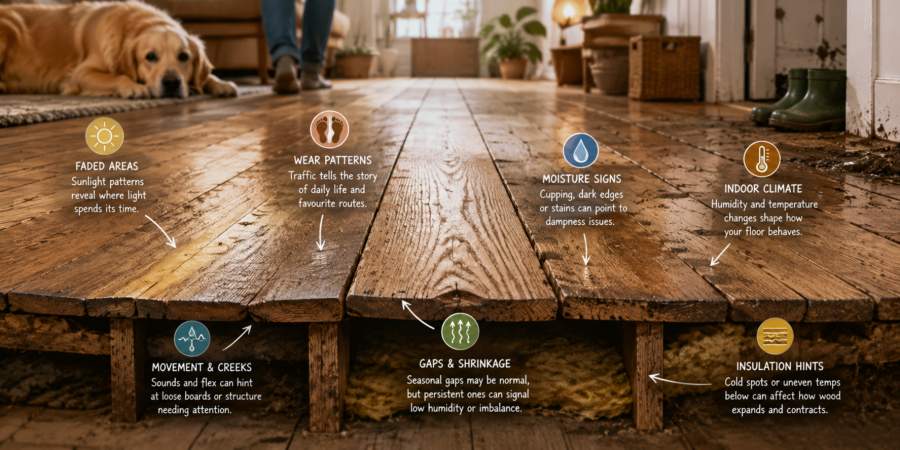
A timber floor records habits with surprising honesty. It notices where people gather, where sunlight lingers, and how indoor air changes from season to season. While walls may conceal their secrets behind paint and furniture politely pretends everything is fine, flooring tends to be more direct.
Grain Patterns and Silent Clues
Wood grain is often admired for its appearance, yet it also tells a practical story. Each plank contains natural variations shaped by growth conditions and the species itself. Those lines and swirls are not decorative accidents. They influence how boards expand, contract, and age.Some homeowners worry when they notice one plank behaving differently from another. Slight variation is entirely normal. Wood is a natural material, and expecting perfect uniformity from it is rather like expecting siblings to agree on holiday plans.
More important is how those planks respond over time. Boards with raised edges, cupping, or uneven surfaces may suggest excess moisture beneath or within the room. Kitchens, entrances, and poorly ventilated spaces often reveal these changes first. When moisture lingers, wood absorbs it and reacts accordingly.
This is not merely cosmetic. Persistent moisture can point to plumbing concerns, inadequate ventilation, or damp conditions affecting the subfloor. A floor may quietly announce trouble months before stains appear on walls or ceilings.
Footsteps Leave More Than Memories
Wear patterns provide another layer of evidence. Floors develop paths in the same way parks develop unofficial shortcuts across grass. People are creatures of habit, and timber records those habits without judgement.Shinier areas near doorways, faded zones around kitchen counters, or softened finishes beside sofas reveal how rooms are truly used rather than how they were intended to be used. Estate agents may describe a room as multifunctional, but the floor usually knows where everyone actually stands while debating what to watch or searching for misplaced keys.
Heavy wear in concentrated spots can also reveal furniture placement that restricts movement or traffic routes that create unnecessary strain on specific boards. In some homes, these marks become a map of daily life.
Sometimes those worn areas reveal something less sentimental and more practical. Uneven wear may indicate subtle movement in the floor structure or minor leveling problems beneath the surface. If one section appears to age faster than the rest, the cause may extend beyond enthusiastic pacing during phone calls.
Gaps That Speak Up
Gaps between boards often cause alarm, particularly when they appear during colder months. Yet timber responds continuously to its environment. Changes in humidity and temperature encourage boards to shrink and expand throughout the year.Small seasonal gaps are usually part of that natural cycle. Indoor heating lowers humidity, drying the wood and encouraging contraction. When moisture levels rise again, many floors settle back into place with impressive confidence, as though nothing happened at all.
However, larger or persistent gaps deserve closer attention.
Consistent spacing that fails to close may suggest overly dry indoor conditions, insufficient acclimatisation before installation, or underlying moisture imbalance elsewhere in the property. Homes with aggressive heating systems often reveal this clearly. A room may feel comfortably warm while the floor quietly negotiates terms for continued cooperation.
Maintaining balanced indoor humidity is therefore more than a comfort issue. It affects the stability and longevity of timber flooring and can influence the condition of furniture, joinery, and even musical instruments stored indoors.
Movement Beneath Your Feet
Movement is another message worth understanding.A slight bounce or isolated creak does not automatically signal disaster. Older properties, particularly those with suspended timber floors, often develop sounds and movement over time. Structural materials settle, fastenings loosen, and daily use leaves its mark.
Yet changes in movement should never be ignored. Increasing flex, repeated lifting at board edges, or new sounds appearing across larger sections may point toward weakened supports, shifting subfloors, or insulation concerns.
Insulation problems are particularly revealing. Cold spots beneath flooring can create inconsistent temperatures that influence how wood behaves. In poorly insulated areas, boards may respond more dramatically to environmental changes. That chilly patch near the hallway may not simply be the house displaying personality.
Where airflow beneath suspended floors becomes excessive or uneven, timber may dry too quickly in some sections while remaining stable in others. The result can be distortion, movement, and accelerated wear.
Board Meetings and Home Truths
Wooden floors reward observation. They document moisture levels, traffic habits, indoor climate, and structural shifts with remarkable honesty. Rather than treating every creak or gap as a crisis, homeowners benefit from seeing these details as information.A floor that changes is not necessarily failing. More often, it is responding to its surroundings and offering clues about the home above and below it. Paying attention to those signals allows problems to be addressed earlier and maintenance decisions to become more informed.
Timber flooring spends decades carrying furniture, footsteps, pets, and the occasional regrettable indoor plant experiment. The least it can do is share what it knows. Fortunately, it usually does. One plank at a time.
Article kindly provided by exenflooring.co.uk