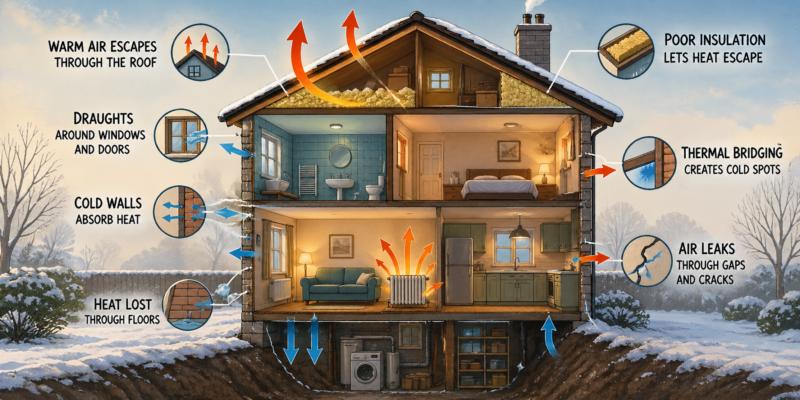
A cold home is not always caused by a weak heating system. Often, the heat is being produced perfectly well; it is simply escaping, stalling, drifting upward, or being bullied by cold surfaces before you get to enjoy it. This is why one room can feel cosy while another feels like it has been personally sponsored by January.
Heat Loss Is Sneakier Than It Looks
Heat does not only vanish through obvious places like open windows or badly fitted doors. It also slips through loft spaces, wall cavities, floorboards, unsealed pipe gaps, thin glazing, and poorly insulated corners. These small weaknesses can combine into a serious comfort problem.A heating system warms the air, but your home’s structure decides how long that warmth sticks around. If ceilings, walls, floors, and windows are poorly insulated, they absorb or lose heat quickly. You may turn the thermostat up, but the room still feels chilly because the surfaces around you remain cold. Your body notices those cold surfaces even when the air temperature looks acceptable on paper.
Thermal Bridging Is the Quiet Villain
Thermal bridging happens when part of a building allows heat to pass through more easily than the surrounding area. Common examples include metal fixings, concrete lintels, wall junctions, window frames, and poorly insulated corners. These spots act like tiny escape routes for warmth.The result can be cold patches, condensation, and rooms that never feel properly comfortable. You may also notice mould forming in corners or around windows, not because your house is being dramatic, but because cold surfaces encourage moisture to settle there.
Finding these weak spots does not always require expensive equipment. On a cold day, slowly move your hand around window edges, skirting boards, sockets, loft hatches, and external wall corners. Draughts, cold patches, and sudden temperature changes are clues. Your hand becomes a budget detective, minus the trench coat.
Airflow Plays Tricks on Comfort
Warm air has a habit of rising, which sounds helpful until you realise it prefers the ceiling more than your feet. If air is not circulating well, you can end up with warm ceilings and cold seating areas, which is not particularly useful unless you plan to live on a ladder.Draughts make matters worse. Small, constant streams of cold air entering through gaps can disrupt warm air layers and create uneven temperatures. Even if your thermostat says everything is fine, that sneaky airflow can make the room feel colder than it technically is.
Curtains, furniture placement, and even radiator covers can interfere with airflow. Blocking a radiator traps heat behind objects instead of allowing it to spread into the room. A sofa pressed tightly against a radiator might be enjoying a luxurious experience, while the rest of the room shivers politely.
Simple Ways to Spot and Fix Heat Loss
Improving warmth does not always mean a full renovation. Many issues can be identified and improved with small, practical changes.- Seal gaps around windows, doors, and pipe entries using draught excluders or sealant
- Check loft insulation levels and top them up if needed
- Use thick curtains or blinds to reduce heat loss through glazing at night
- Avoid blocking radiators with furniture or covers
- Lay rugs on bare floors to reduce heat loss downward
- Install reflective panels behind radiators on external walls
Surface Temperature Matters More Than You Think
Comfort is not just about air temperature. It is about the temperature of the surfaces around you. Cold walls, windows, and floors pull heat away from your body, making the room feel colder than the thermostat suggests.Improving insulation raises surface temperatures, which helps the entire space feel warmer without needing more heat. This is why two rooms set to the same temperature can feel completely different. One holds onto warmth, the other lets it slip away like it has somewhere better to be.
Heating Smarter Not Harder
Turning up the thermostat often feels like the obvious solution, but it treats the symptom rather than the cause. If heat loss is high, you are simply feeding energy into a system that cannot retain it effectively.Focusing on insulation, airflow, and eliminating weak spots allows your heating system to do its job properly. It works less, maintains warmth more consistently, and stops your home from feeling like it has a secret agreement with the outdoors.
Warming Up to Better Habits
A comfortable home is not just about generating heat; it is about keeping it where it belongs. Once gaps are sealed, airflow is balanced, and surfaces are warmer, the difference becomes noticeable quickly. Rooms feel stable instead of unpredictable, and your heating system finally gets the appreciation it deserves rather than being blamed for everything.A house that holds onto heat properly stops playing tricks. It becomes consistent, efficient, and far less likely to leave you wondering why your socks are still not enough.
Article kindly provided by eco-friendlyheating.co.uk