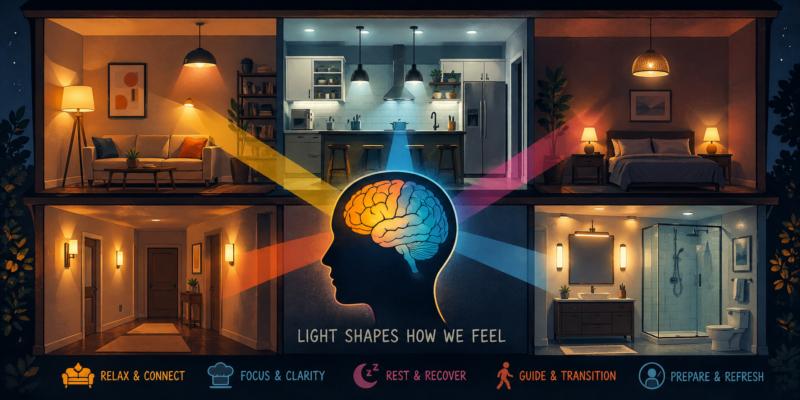
Most people treat lighting as a functional checkbox: can you see clearly, yes or no? But light has layers—intensity, direction, warmth—and each of those elements sends signals to the brain. Those signals influence whether you relax, stay alert, linger in conversation, or quietly look for an excuse to leave the room.
Living Rooms and the Art of Lingering
A living room should invite people to stay a while. If the lighting feels like a supermarket aisle, it won’t. Bright overhead lights flatten everything, eliminating shadows and depth, which oddly makes a space feel less comfortable rather than more visible.Lower, warmer lighting creates contrast and softness. Table lamps, floor lamps, and even wall lighting introduce variation that mimics natural light patterns. This signals the brain to relax. Conversations stretch out longer, and people stop checking the time quite so often.
There’s also the question of placement. Lighting from multiple angles prevents harsh shadows on faces, which, while subtle, affects how people perceive each other. Nobody consciously says, “This lighting makes you look unapproachable,” but the effect is there.
Overhead lighting isn’t the enemy—it just needs to learn its place. Think of it as the backup singer, not the lead.
Kitchens and the Need for Clarity
Kitchens operate on a different wavelength. This is where precision matters—chopping, measuring, timing—and the lighting should support that without turning the space into an interrogation room.Cooler, brighter light improves visibility and alertness, making tasks easier and safer. But intensity needs to be controlled. A single harsh ceiling light can create deep shadows right where you’re working, which defeats the entire purpose.
Layered lighting solves this neatly:
- Task lighting under cabinets to illuminate work surfaces
- Ambient lighting to fill the room evenly
- Accent lighting for visual balance and warmth
Hallways That Shape First Impressions
Hallways don’t get much attention, yet they quietly set expectations. A dim, unevenly lit hallway can make a home feel smaller and slightly unwelcoming, even if every room beyond it is thoughtfully designed.Consistent, soft lighting creates a sense of flow. Wall-mounted fixtures or evenly spaced lights guide movement and reduce visual interruptions. It’s less about brightness and more about rhythm—light leading you forward without demanding attention.
There’s also a psychological transition happening. Moving from one space to another should feel natural, not abrupt. Lighting helps smooth that transition, acting almost like punctuation between rooms.
Ignore the hallway, and the rest of the home has to work harder to recover from the first impression.
Bedrooms and the Subtle Art of Switching Off
Bedrooms exist for one primary purpose, yet lighting often works against it. Bright, cool-toned light tells the brain to stay alert, which is not especially helpful when the goal is sleep. It’s a bit like inviting someone to relax while simultaneously blasting them with fluorescent enthusiasm.Warmer, dimmable lighting helps signal that the day is winding down. The key is control—being able to gradually reduce brightness rather than jumping from full intensity to darkness in one dramatic move. That sudden shift tends to feel less like relaxation and more like a power outage.
Bedside lighting also plays a role beyond practicality. Soft, directional light creates a personal zone that feels contained and calm. It’s not just about reading comfortably; it’s about creating a boundary between the outside world and a quieter, more private space.
Even small adjustments—lower wattage bulbs, repositioned lamps—can make a bedroom feel noticeably more restful without changing anything else in the room.
Bathrooms and the Morning Reality Check
Bathrooms demand honesty. Lighting here needs to be clear enough for grooming tasks but forgiving enough that it doesn’t feel like a forensic examination.Overhead-only lighting tends to cast shadows under the eyes and chin, which is rarely flattering and often unnecessarily dramatic. Side lighting, placed at eye level, reduces these shadows and creates a more balanced reflection. It’s a small change that makes a surprising difference in how people perceive themselves at the start of the day.
Brightness matters, but so does tone. Neutral to slightly warm light strikes a balance between accuracy and comfort. Anything too cold can feel stark; anything too warm can distort color. There’s a sweet spot where everything looks right without looking exaggerated.
And yes, there’s a psychological benefit to not feeling personally attacked by your own mirror first thing in the morning.
Let There Be Lightness
Lighting doesn’t need a full redesign to change how a home feels. Small, deliberate adjustments—moving a lamp, swapping a bulb, adding a second light source—can shift the entire mood of a room.The underlying principle is simple: match the lighting to the behavior you want the space to support. Relaxation calls for warmth and softness. Focus benefits from clarity and brightness. Movement flows better with consistency and subtle guidance.
When those elements align, rooms begin to feel intuitive rather than awkward. People settle in more easily, tasks feel less strained, and the space starts working with you instead of against you.
Light doesn’t need to shout to be effective. Most of the time, it’s doing its best work quietly, shaping experience in ways that only become obvious once something feels just right—or unmistakably wrong.
Article kindly provided by cplights.com