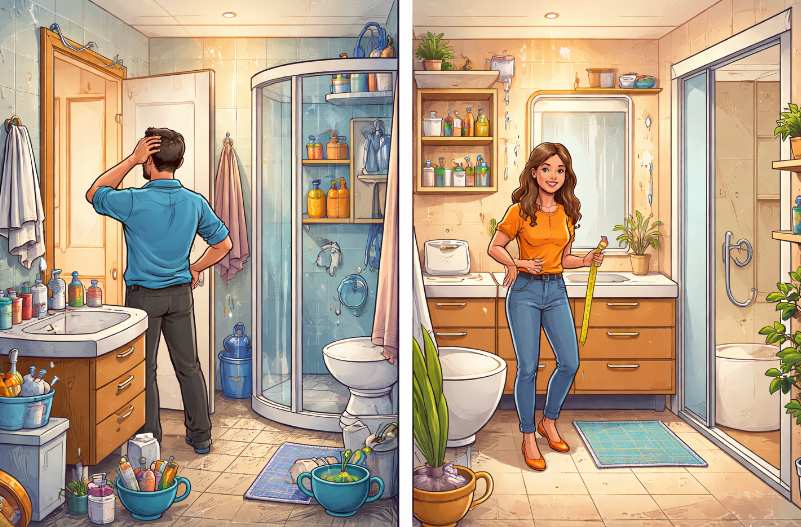
When Fixtures Compete for Attention
Bathrooms often suffer from what could be called “fixture crowding.” Everything is technically in the right place, but nothing quite fits together. A bulky vanity might dominate the room, leaving barely enough clearance to open a cabinet without bumping into the toilet.Repositioning isn’t always necessary. Sometimes it’s about choosing smarter shapes and proportions. Wall-mounted sinks, for example, free up floor space and make the room feel less cramped. Corner basins can turn previously wasted angles into functional areas. Even swapping a wide vanity for a slimmer model can make movement feel natural again instead of like navigating a tight hallway.
A bathroom should not feel like it’s testing your coordination. If you have to sidestep your own sink, something has gone wrong.
The Door That Steals Your Space
Doors are surprisingly greedy when it comes to space. A traditional inward-swinging door can consume a significant portion of usable floor area, often blocking access to fixtures or storage.Switching to a sliding or pocket door can immediately reclaim that lost space. It’s a relatively modest change with a disproportionately large impact. Even reversing the direction of a door swing can improve flow, making the room feel more open without altering its footprint.
There’s something deeply frustrating about designing a room only to have the door dictate how everything else must behave. It’s like inviting a guest who rearranges your furniture the moment they arrive.
Storage That Works Against You
Storage is essential, but badly planned storage can create more problems than it solves. Deep cabinets that swallow items whole, shelves placed too high to reach comfortably, or units that protrude awkwardly into walking space all contribute to inefficiency.Instead, consider vertical storage solutions that make use of wall height rather than floor area. Recessed shelving, mirrored cabinets, and tall, narrow units can dramatically increase storage without crowding the room.
- Use recessed niches in shower walls for toiletries
- Install floating shelves above toilets or radiators
- Choose mirrored cabinets that double as storage
Oversized Fixtures in Modest Spaces
A common mistake is selecting fixtures that belong in a much larger room. A freestanding bath might look impressive, but in a compact bathroom, it can dominate the space to the point of impracticality.Scaling fixtures appropriately is key. Compact bathtubs, shorter projection toilets, and slimline basins are designed specifically for smaller spaces. They offer full functionality without overwhelming the room.
There is a certain irony in installing a luxurious feature that makes the rest of the room inconvenient to use. Comfort should extend beyond appearances.
Awkward Gaps and Dead Zones
Many bathrooms contain small, unusable gaps—those narrow spaces between fixtures or walls that serve no real purpose. These areas often go unnoticed, yet they represent missed opportunities for better design.Filling these gaps with custom or modular storage can transform them into practical features. Slim pull-out units, narrow shelving, or even built-in hampers can make use of spaces that would otherwise collect dust and the occasional forgotten cleaning product.
Dead space is rarely truly dead. It’s just waiting for a more thoughtful approach.
Lighting That Shrinks the Room
Poor lighting doesn’t just make a bathroom look dull; it can also make it feel smaller than it really is. A single overhead light tends to cast shadows that flatten the space, making corners feel tighter and surfaces less defined.Layered lighting changes everything. Combining overhead lights with wall-mounted fixtures and mirror lighting creates depth and openness. Well-lit mirrors, in particular, reduce visual clutter and make daily routines easier, which is always appreciated before the first cup of coffee.
A brighter bathroom feels larger, even if nothing else has changed. It’s one of the simplest ways to improve the overall experience without moving a single fixture.
Ignoring Flow and Movement
A functional bathroom allows you to move through it without thinking too much about where to step next. When layout issues disrupt that flow, even routine tasks become slightly irritating.Think about the sequence of use. The sink should be easily accessible from the door. The toilet shouldn’t feel like it’s hiding behind an obstacle course. The shower or bath should have enough clearance to enter and exit comfortably without bumping into anything.
Small adjustments can make a noticeable difference. Shifting a towel rail, relocating a bin, or choosing fixtures with better spacing can restore a sense of order. It’s not dramatic work, but it’s effective.
A well-planned bathroom feels intuitive. You don’t notice it working well, which is exactly the point.
Overlooking Wall Space Potential
Walls are often underused, treated as mere boundaries rather than opportunities. Yet they offer valuable real estate for both storage and design improvements.Wall-mounted units, hooks, and organisers can free up floor space and reduce clutter. Even something as simple as relocating frequently used items to eye level can improve usability.
There’s also a visual benefit. Keeping the floor clear creates the illusion of a larger room, making even compact bathrooms feel more spacious. It’s a subtle trick, but a powerful one.
Ignoring wall space is like leaving an entire shelf empty while complaining about a lack of storage. The solution is right there, quietly waiting to be used.
Rethinking What You Already Have
Improving a bathroom layout doesn’t always require new purchases. Sometimes, it’s about re-evaluating what’s already in place.- Reposition accessories to reduce clutter
- Replace bulky items with slimmer alternatives
- Remove anything that serves no clear purpose
Flush With Better Ideas
Making a bathroom more efficient doesn’t have to involve major disruption or significant expense. By focusing on layout, proportions, and thoughtful use of space, it’s possible to transform how the room functions without changing its size.Small decisions add up. A better-placed fixture, a smarter storage choice, or a more considerate door arrangement can turn a cramped, awkward bathroom into one that feels calm and practical. And once everything works as it should, the room finally stops competing with you and starts cooperating instead.
Article kindly provided by riccobathrooms.co.uk