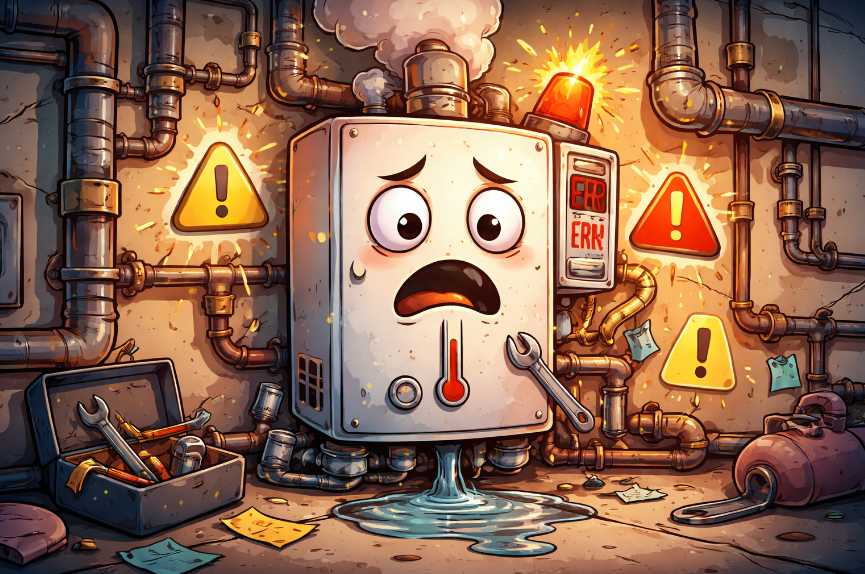
Learning to spot the early warnings matters because small issues tend to grow teeth. A minor pressure problem can become a shutdown. A faint knocking sound can become a repair bill with enough zeroes to make you stare into the distance. Paying attention early often means less disruption, less expense, and a much smaller chance of discovering your boiler’s personality at 6am in January.
Pressure drops are not just numbers on a dial
If your boiler pressure keeps falling, it is not being dramatic for the fun of it. Low pressure often points to a leak somewhere in the system, a recently bled radiator, or a failing component such as the pressure relief valve or expansion vessel. Any of those can affect how well your heating works.You might notice radiators taking longer to heat up, the boiler switching itself off, or the pressure gauge drifting lower every few days. Topping it up once after bleeding radiators is normal. Topping it up repeatedly is not maintenance. That is your boiler waving a small red flag and hoping somebody in the household is paying attention.
Serious point now. If pressure loss is frequent, it needs checking properly. Repeatedly repressurising without finding the cause can place stress on the system and hide a more important fault.
Odd noises usually mean something is happening inside
Boilers are not silent creatures, but they should not sound like they are rehearsing for a percussion solo. Banging, gurgling, whistling, or vibrating noises can suggest trapped air, limescale buildup, pump problems, or restricted water flow.A kettling sound, for example, often happens when limescale or sludge interferes with heat transfer inside the heat exchanger. Water overheats in one spot, starts to steam, and creates that sharp, angry noise. Gurgling may point to air in the system. A persistent hum or rattle can mean a fan or pump is struggling.
Some noises are more annoying than dangerous. Others are the mechanical equivalent of clenched teeth. If a sound is new, repeated, or getting worse, treat it as useful information rather than background character.
Uneven heating can reveal problems beyond the radiators
When one room feels tropical and another feels fit for penguins, the issue may not be the thermostat alone. Cold spots on radiators often suggest sludge buildup. Radiators that stay cool upstairs may point to circulation or balancing problems. Hot water that turns lukewarm halfway through a shower can signal issues with diverter valves or heat exchange.Inconsistent heating tells you the system is no longer working cleanly or evenly. That is worth taking seriously, even if the boiler still technically works. A heating system does not need to fail completely to be inefficient, wasteful, and quietly expensive.
Short cycling is your boiler’s way of pacing nervously
A boiler that switches on and off frequently, known as short cycling, is not being efficient. It is struggling to maintain the right conditions. This can be caused by thermostat issues, poor water flow, incorrect pressure, or a component that is starting to fail.You may notice the boiler firing up, running briefly, shutting down, and then repeating the process again and again. It is the mechanical equivalent of someone starting a task, stopping halfway, and starting over repeatedly. Aside from being frustrating, this behaviour increases wear on internal parts and pushes up energy use.
A system that cycles too often is telling you it cannot settle into a steady rhythm. That is not something to ignore, even if heat is still being produced.
Pilot lights and error codes are not decorative features
Modern boilers come with displays and indicators designed to communicate problems clearly. If an error code appears, it is not there for aesthetic balance. It is pointing directly to a fault or condition that needs attention.Similarly, if the pilot light frequently goes out or changes colour, that can indicate issues with gas supply, ventilation, or internal components. These are not situations to troubleshoot casually. They require proper inspection, especially where safety could be involved.
- Error codes that repeat after resetting
- Lights that flicker, change colour, or fail to stay lit
- Lockouts that occur without an obvious cause
Small habits that prevent large problems
Not every issue requires immediate intervention, but small actions can keep your system in a healthy state. Bleeding radiators when needed, checking pressure occasionally, and scheduling regular servicing all help prevent gradual decline.It is easy to treat a boiler as a background appliance, something that quietly does its job without attention. In reality, it benefits from the occasional glance and a bit of care. Think of it less like a mysterious box and more like a system that responds well to being noticed before it starts complaining loudly.
Final thoughts from a machine that prefers not to shout
A boiler does not fail silently. It signals, hints, and occasionally protests long before anything dramatic happens. Pressure changes, unusual sounds, inconsistent heat, and repeated shutdowns are all part of its communication style. Ignoring those signals turns small, manageable issues into urgent repairs.Paying attention early does not require technical expertise. It requires curiosity and a willingness to act when something seems off. That simple approach keeps your home warm, your costs predictable, and your boiler far less likely to stage an untimely rebellion.
Article kindly provided by daleygasgroup.co.uk