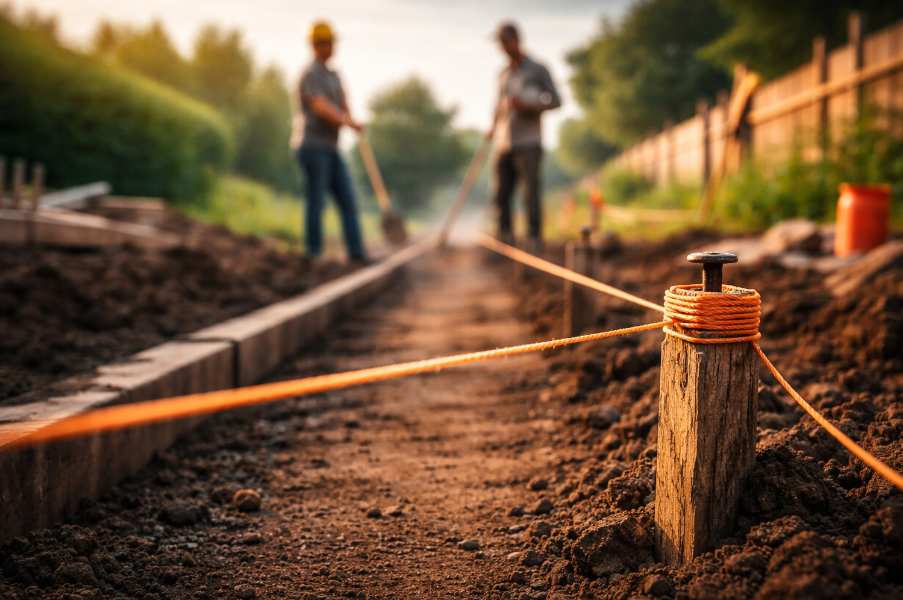
Modern tools promise instant accuracy. They beep, blink, and sometimes require a software update. Yet when a fence must run straight across thirty yards of yard, or bricks need to sit obediently in a perfect row, professionals still reach for a simple cord pulled tight between two points. Technology impresses the eye. A string line quietly wins the argument.
Straight Lines Without Batteries
Construction crews often carry laser levels and digital measuring tools, but a string line remains the fastest way to establish visual alignment. Two stakes, a length of cord, and a steady pull create an instant reference line that anyone on the site can follow. It works in bright sun, dusty wind, and places where electronics prefer to sulk.Bricklayers, fence installers, and landscapers use the line as a visual ruler stretched across space. Lay bricks until they just kiss the string without pushing it out of place. Align fence posts so they stand proudly beneath the cord. Plant shrubs so a garden bed doesn’t wander like a distracted tourist.
Precision comes from simplicity. A taut line forms a straight path because tension distributes evenly along the cord. No calibration menu required.
Why Builders Still Trust It
Several qualities make string lines hard to replace.- Immediate setup with almost no tools
- Clear visual reference for entire crews
- Reliability in outdoor conditions
- Low cost compared with digital equipment
Even experienced contractors admit that when accuracy matters, the simplest method often reduces mistakes. Technology can help measure distances, but it rarely replaces the clarity of a straight physical guide running exactly where work should happen.
There’s also a quiet psychological benefit. A visible line encourages careful work. No one wants to be the person who laid the one crooked brick everyone can see from across the yard.
Tension Makes the Magic
A string line only performs well when properly tensioned. Loose cord behaves like a lazy hammock and produces results that resemble abstract art rather than straight construction.Pulling the line tight between stakes ensures it stays level and straight. Professionals often wrap the cord several times around a stake and pull firmly before tying it off. The goal is enough tension that the line hums slightly when plucked. If it produces a sad wobble instead, more tightening is required.
Long distances introduce another challenge. Even strong cord will sag slightly under its own weight. To counter this, builders sometimes elevate the stakes or run shorter segments of line rather than stretching a single piece across the entire project.
Careful placement matters as well. The string should sit exactly where the finished edge will be, not somewhere vaguely nearby. A few inches of guesswork can turn a neat layout into a slow afternoon of corrections.
Accuracy often depends less on tools and more on patience. Tighten the line. Step back. Check it again. Small adjustments early prevent large regrets later.
Keeping Sag and Wobble Under Control
Even the best string line will betray its user if it’s treated carelessly. Gravity is persistent, and over longer distances the cord naturally wants to dip. The trick is managing that tendency before it turns a straight guide into something resembling a gentle smile.One common approach is to shorten the span between anchor points. Instead of stretching a single line across an entire yard, professionals often break the layout into sections. Each segment stays tight, visible, and trustworthy.
Another helpful tactic involves raising the line slightly above the work surface. When the cord sits a bit higher, it becomes easier to see whether bricks, boards, or posts are creeping past the guide. The line should hover just enough that materials can approach it without pushing it aside.
Wind introduces its own form of mischief. A breezy afternoon can turn a loose line into something that behaves like a jump rope auditioning for a circus act. Tension reduces this problem dramatically. A firmly stretched cord remains stable, even when the weather decides to participate.
Attention to these small details separates a tidy layout from the kind that causes someone to stand back, squint, and quietly say, “Well… that’s interesting.”
Visual Alignment That Everyone Understands
One underrated advantage of a string line is how clearly it communicates direction. On a busy job site, instructions can easily become a game of telephone. Someone says “move it a little left,” another person hears “move it a lot left,” and suddenly the project resembles modern art.A taut line eliminates interpretation. The correct position sits directly beneath it. If something touches the line, it’s too far. If it sits well behind the line, it needs adjustment. Even someone new to the work can understand the rule within seconds.
Landscaping crews use this visual cue constantly. Garden borders, stone paths, and retaining walls benefit from the guidance of a straight cord. The same applies to fence installation. Posts placed along a stretched line naturally form a consistent boundary instead of drifting like a group photo where everyone stood wherever they felt comfortable.
Consistency matters in construction. A small deviation repeated twenty times becomes impossible to ignore. String lines keep each step disciplined so the finished work looks intentional rather than accidental.
Getting the Most From a Simple Tool
Using a string line effectively requires only a few habits, but they make a noticeable difference.- Anchor stakes firmly so they won’t shift during work
- Pull the cord tight enough to eliminate visible sag
- Check alignment from multiple angles before beginning
- Re-tighten the line if it loosens during the project
Many seasoned builders quietly appreciate tools that never demand charging cables or software updates. A spool of line and a couple of stakes can sit in a toolbox for months, then return to duty the moment a straight reference becomes necessary.
Sometimes progress means adding technology. Other times it means recognizing that an older method already solved the problem elegantly.
A Line Worth Following
Construction history is filled with clever inventions, yet few tools deliver as much usefulness with so little complexity as a stretched cord. It defines boundaries, guides careful work, and quietly ensures that rows stay obediently straight.When someone pulls a string tight between two stakes, they’re performing a technique that has guided builders for generations. No display screen, no calibration process, just a simple visual truth suspended in the air.
Sometimes the straightest path forward really is just a line.
Article kindly provided by acesupplyusa.com