A driveway that lasts thirty years rarely owes its durability to the visible top layer alone. Strength begins below, where most homeowners never look and installers sometimes rush. What lies beneath determines whether the surface calmly supports vehicles for decades or gradually develops the personality of a wavy potato chip.
Subgrade Preparation Is Where the Real Work Begins
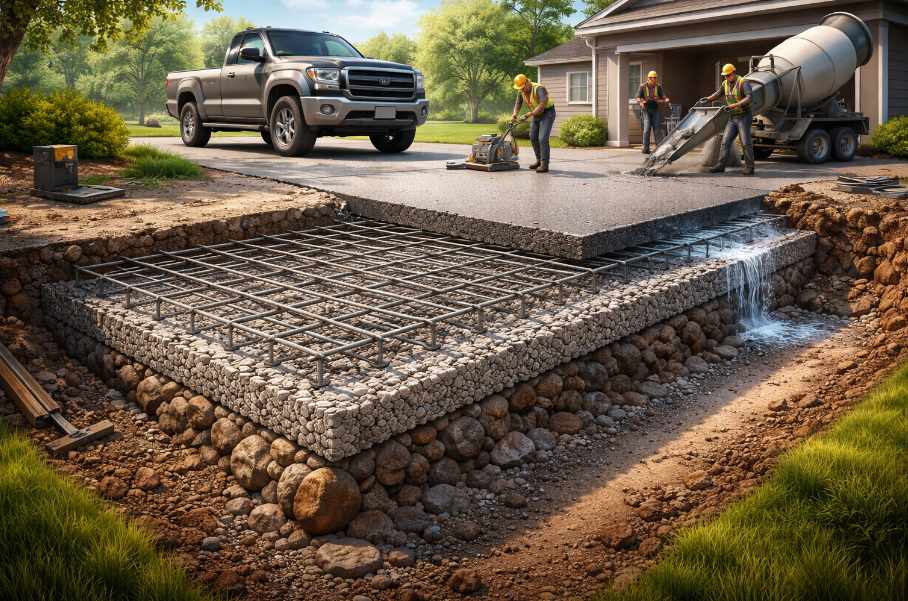
Under every reliable driveway sits a prepared subgrade. This is the soil layer that supports everything above it. If that soil is poorly compacted, uneven, or filled with organic material, the driveway may appear flawless at first. Give it a few seasons, and gravity begins its quiet campaign.Proper preparation involves removing loose soil, roots, and debris before compacting the ground thoroughly. Contractors often bring in crushed stone or gravel to form a stable base. That layer spreads the weight of vehicles evenly and prevents localized sinking.
Skipping this step saves time on installation day but creates problems later. The surface might settle unevenly, producing dips where rainwater gathers like it has reserved parking. Once water begins sitting on a driveway, deterioration accelerates.
In serious installations, compaction equipment ensures the soil and base layers are tightly packed. Each pass reduces air pockets that would otherwise collapse under weight. Think of it as preparing a mattress for several thousand pounds of rolling metal.
Reinforcement That Quietly Handles the Heavy Lifting
Concrete driveways often include reinforcement such as steel rebar or wire mesh. These materials are embedded within the slab and help distribute loads while resisting cracking. Without reinforcement, concrete can behave like a stubborn cracker. It looks sturdy until pressure arrives from an awkward angle.Steel reinforcement gives the slab tensile strength. Vehicles exert downward pressure, but temperature changes also cause concrete to expand and contract. Reinforcement helps keep those movements controlled instead of chaotic.
A well-reinforced driveway manages several stress factors simultaneously:
- Weight from vehicles
- Temperature expansion and contraction
- Minor soil shifts beneath the slab
- Freeze-thaw cycles in colder climates
Experienced installers position reinforcement carefully within the slab rather than letting it rest on the ground. Placement matters because the steel must sit where stress occurs, not where it politely avoids responsibility.
Done correctly, reinforcement works invisibly for decades. Most homeowners never see it, yet it quietly carries the burden of every parked car, delivery truck, and occasional relative who insists on backing in at full enthusiasm.
Slope That Sends Water Packing
A driveway might look perfectly flat, but the best ones are slightly sloped. That subtle angle encourages rainwater to drain away rather than linger.Water sitting on pavement is not a decorative feature. It seeps into small pores, freezes during cold weather, expands, and gradually weakens the surface. Repeated freeze-thaw cycles can turn a pristine driveway into something resembling abstract art.
Engineers typically design driveways with a gentle slope away from structures and toward drainage areas. The angle is small enough to remain unnoticed but effective enough to keep water moving.
Gravity does the rest of the job without asking for overtime pay.
Installers who ignore drainage create driveways that become shallow ponds after rainstorms. Aside from being inconvenient, standing water accelerates surface breakdown and softens the base layers beneath.
A driveway that drains well avoids these problems quietly and efficiently. Most of the time, nobody even notices the slope until they watch rainwater glide away instead of settling in for a long visit.
Curing Techniques That Decide the Driveway’s Future
Fresh concrete might look finished within hours, but internally it is still busy transforming from a wet mixture into a hardened structural material. This stage is known as curing, and it plays a major role in determining how strong the slab ultimately becomes.Concrete gains strength through a chemical reaction between cement and water called hydration. If moisture disappears too quickly during those early days, the reaction stops prematurely. The surface may look fine, yet the internal structure ends up weaker than intended.
Professional installers often keep concrete moist during the curing period. This can involve applying curing compounds, covering the slab with plastic sheeting, or lightly misting it with water. Each method slows evaporation and allows the material to reach its designed strength.
Rushing this stage is a common reason driveways fail early. When curing is ignored, the surface may develop cracks long before the homeowner has finished admiring the fresh installation. In extreme cases, the slab loses durability against weather and vehicle loads.
Patience during curing might add a few days to a project schedule, but it adds years to the life of the driveway. Concrete that cures properly behaves like a disciplined athlete. Concrete that cures poorly behaves more like someone who skipped every training session and still tried to run a marathon.
Why Some Driveways Fail So Quickly
When a driveway deteriorates early, the cause rarely involves just one mistake. Failures usually come from a chain of shortcuts. Each one seems minor at the time, but together they quietly undermine the structure.Several common installation problems appear repeatedly in premature driveway failures:
- Poorly compacted soil beneath the slab
- Base layers that are too thin
- Missing or improperly placed reinforcement
- Incorrect slope that traps water
- Concrete that was not cured properly
Vehicles add another layer of stress. Passenger cars are manageable loads, yet delivery trucks, garbage trucks, and moving vans exert enormous pressure. A driveway built without adequate structural support gradually bends under that weight.
Over time, bending leads to cracking. Cracking allows water inside. Water expands during freezing temperatures. The driveway eventually becomes a collection of uneven slabs that appear to be negotiating separate treaties with gravity.
Paving the Way to Long-Term Strength
A driveway that lasts decades is rarely accidental. It begins with thoughtful preparation, continues with structural reinforcement, drains water effectively, and cures properly before welcoming its first vehicle.None of these elements are glamorous. Nobody stops to admire compacted gravel or carefully positioned steel reinforcement. Yet those quiet details form the backbone of durability.
When the engineering is done well, the surface remains smooth and stable year after year. Cars come and go, seasons change, and storms pass overhead without leaving much of a mark.
From the outside, it looks like nothing special happened during construction. Beneath the surface, however, a carefully built foundation is doing its job every single day. The driveway simply carries the weight, shrugs off the weather, and keeps pretending that holding up thousands of pounds of metal is no big deal.
Article kindly provided by colinconcretedesmoines.com