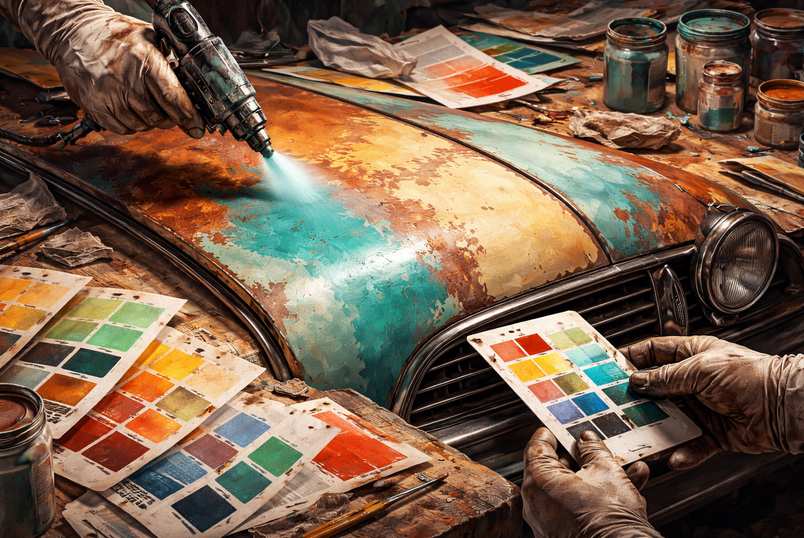
Ageing rarely changes paint evenly. Horizontal panels fade faster than vertical ones. Areas near trim or handles may remain darker, protected by nothing more sophisticated than shade and neglect. Dirt, oxidation, and previous touch-ups complicate the story further. Treating the visible colour as truth is often the first mistake. Careful cleaning and gentle polishing usually reveal a closer version of the original tone, which immediately improves any attempt at matching.
Reading What Time Has Done
Understanding how finishes deteriorate helps narrow the gap between guesswork and accuracy. Ultraviolet exposure breaks down pigments, especially reds and blues, leaving surfaces dull or slightly chalky. Moisture introduces subtle staining. Heat cycles encourage tiny cracks that scatter light differently. None of this is dramatic on its own, yet together they shift colour enough to make a fresh coating look embarrassingly new—like turning up to a historical drama wearing modern trainers.A serious approach begins with inspection under consistent lighting. Natural daylight is honest, sometimes brutally so. Artificial lighting can tint perception in ways that sabotage careful work. Viewing the surface from multiple angles also matters because gloss level influences how colour is perceived. Two identical pigments can appear unrelated if one reflects light sharply and the other diffuses it.
Small sample areas provide reassurance before larger decisions. Testing inside hidden edges, beneath trim, or on removable components reduces risk. Comparing dried samples rather than wet paint prevents disappointment later, since evaporation and curing subtly adjust tone and sheen.
Sampling Before Committing
Accurate recreation depends on disciplined sampling rather than optimism. Mixing, applying, and evaluating multiple small variations may sound tedious, but it saves time, money, and colourful language that neighbours were never meant to hear. Effective sampling usually follows a simple rhythm:- Clean and lightly prepare the original surface to reveal its truest remaining colour.
- Create incremental shade adjustments rather than one dramatic guess.
- Allow each test to dry fully before judging success or failure.
- Check appearance in both shade and direct daylight.
Careful groundwork sets the stage for blending and layering techniques that make repairs disappear rather than announce themselves.
Layering for Visual Continuity
Perfect colour matching alone does not guarantee an invisible repair. Surrounding surfaces have aged together, sharing the same sunlight, weather, and accidental encounters with everyday life. Fresh paint placed abruptly beside that history can appear overly confident, as though it skipped the years everyone else endured. Layering techniques soften this contrast and allow new coatings to settle into their surroundings with subtlety rather than bravado.Feathering edges is one of the most reliable strategies. Gradually reducing paint thickness toward the boundary prevents harsh visual lines. Light intermediate coats help control opacity, giving the restorer a chance to pause, evaluate, and resist the universal temptation to fix everything in one enthusiastic pass. Blending into adjacent panels, when practical, further disguises transitions. The goal is harmony, not perfection measured with laboratory seriousness.
Serious projects benefit from patience between coats. Drying and curing times influence gloss, depth, and durability. Rushing this stage often produces finishes that look acceptable for a week and suspicious forever after. Allowing materials to behave as intended is less exciting in the moment but far more satisfying months later.
Managing Sheen, Texture, and Expectations
Colour receives most of the attention, yet sheen and surface texture quietly determine whether a repair blends or stands apart. A slightly different gloss level can make a correct colour appear wrong. Matching the final finish—matte, satin, or gloss—deserves the same care as matching pigment. Gentle polishing or controlled flattening can bring surfaces into alignment without dramatic intervention.Texture also tells a story. Older coatings may carry faint orange peel, fine scratches, or softened reflections. Reproducing these characteristics in moderation helps new paint feel appropriately settled. Completely flawless sections can look suspicious, like a single perfect tooth in an otherwise realistic smile.
Expectations benefit from calibration as well. Absolute invisibility is not always realistic, especially on heavily weathered surfaces. However, achieving a result that disappears under normal viewing conditions is both attainable and worthwhile. Restoration succeeds when attention moves away from the repair and back to the object itself.
A Finish Worth a Second Look
Recreating faded or unknown paint finishes combines observation, restraint, and a willingness to learn from small experiments. Each careful sample, measured layer, and patient pause contributes to a surface that feels authentic rather than newly imposed. The process rewards those who respect detail and quietly punishes shortcuts with enduring visibility.When the repaired area finally blends into its surroundings, the achievement is subtle but deeply satisfying. Nothing announces success, and that silence is the point. The surface simply looks right again, carrying its years with dignity while hiding the effort required to help it get there.
Article kindly provided by onestoppaints.co.uk