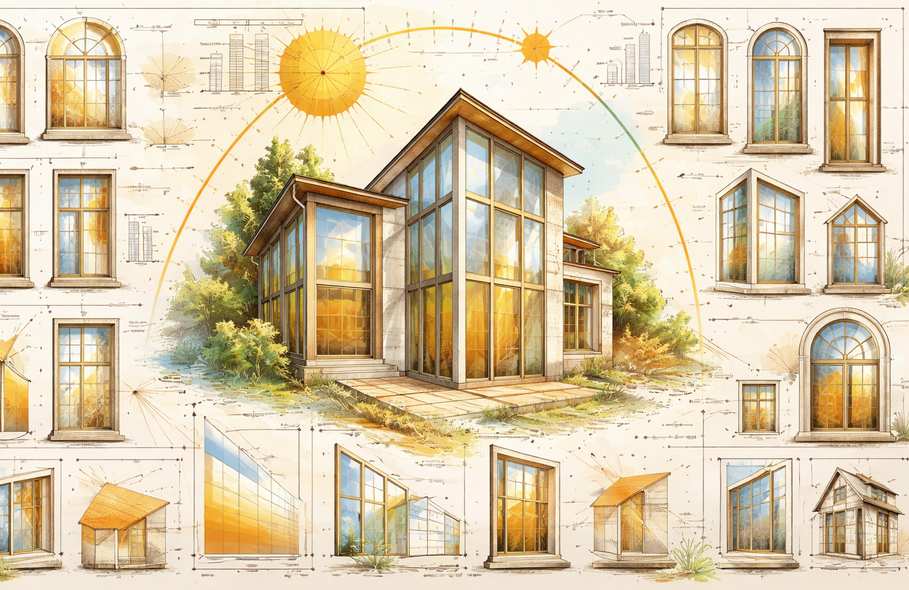
Proportion is not a decorative afterthought; it is a performance decision. The ratio between window and wall area influences daylight levels, solar gain, ventilation potential, and even how occupants feel inside a space. Geometry, meanwhile, governs how that opening interacts with structure, shading, and the movement of the sun. When these factors align, a building feels effortless. When they do not, radiators work overtime and the elevation looks like it lost a debate.
Window to Wall Ratios and the Energy Equation
Window-to-wall ratio, often abbreviated as WWR, sounds technical, but the idea is simple. It measures how much of an exterior wall is made up of glazing compared to solid construction. Push that percentage higher and you invite more daylight and outward views. You also invite more heat loss in winter and more heat gain in summer, unless the glazing specification is carefully chosen.Serious design work begins here. In colder climates, a moderate WWR can balance passive solar gain with insulation performance. South-facing glazing, if proportioned correctly, can reduce reliance on artificial lighting and even contribute to heating during sunny months. Oversized expanses of glass, however, can undermine these gains. Even high-performance glazing does not insulate as effectively as a well-insulated wall.
In warmer climates, large areas of unshaded glass can create overheating issues that no amount of blinds can politely disguise. Strategic sizing, orientation, and shading devices become critical. Horizontal shading works well on south façades where the sun’s path is predictable. Vertical fins can help on east and west elevations where low-angle sunlight is harder to control.
There is also a psychological dimension. Rooms with generous, well-proportioned windows tend to feel larger and more open. Yet, if the glazing overwhelms the wall, the space can feel exposed. Comfort is not only thermal; it is visual and emotional.
Geometry, Shape, and the Way Light Behaves
Rectangular windows dominate modern construction for good reason. They are structurally efficient and easy to integrate with standard materials. But geometry does more than simplify installation. The height-to-width ratio affects how daylight penetrates a room. Taller windows distribute light deeper into the interior, reducing harsh contrasts near the opening.Square windows offer symmetry but may limit vertical light spread. Long horizontal strips create dramatic views yet can concentrate glare at eye level. Circular or arched windows add character, though they require careful detailing to avoid thermal bridging and air leakage around complex frames.
Light does not enter a room evenly. It reflects off ceilings and walls, interacts with floor finishes, and shifts throughout the day. Window geometry determines the initial angle and distribution of that light. A high-level clerestory can wash a ceiling with daylight, creating a softer, more diffuse effect. A low sill height enhances connection to the outdoors but may increase heat transfer at occupant level.
Form also affects ventilation. Vertically proportioned sashes can promote effective stack ventilation when paired with high-level openings. Awning or casement configurations influence how air is captured and directed indoors. Geometry, in short, governs both what you see and how you breathe.
More on retrofits, proportional rules of thumb, and practical design guidance will follow.
Proportion and Visual Balance on the Façade
Good proportions are felt before they are analysed. A façade with well-scaled openings appears settled, even if you cannot immediately explain why. Classical architecture relied on measured ratios, aligning window heights, head lines, and spacing to create rhythm. Contemporary design may reject strict symmetry, yet it still depends on coherence.When windows are too small for the wall plane, the building can look defensive. When they are too large and randomly placed, the elevation starts to resemble a game of architectural pinball. Aligning window heads and sills across storeys creates order. Maintaining consistent vertical proportions reinforces a sense of intention rather than improvisation.
There is also a structural logic at play. Openings weaken walls. Larger spans require stronger lintels and more robust framing. A disciplined geometric strategy supports both aesthetics and performance. Repetition reduces construction complexity and can improve airtightness by limiting custom junctions. Visual calm and thermal efficiency are not enemies; they are often allies.
Practical Tips for Retrofits and New Builds
Retrofitting offers fewer freedoms than a blank sheet of paper, but proportion still matters. Enlarging an existing opening may improve daylight yet disrupt external balance or compromise insulation continuity. Before making changes, consider how the new geometry will affect both façade composition and heat flow.For new builds, early decisions carry long-term consequences. A few grounded principles can help:
- Aim for a window-to-wall ratio that responds to orientation rather than applying a uniform percentage everywhere.
- Prioritise taller window proportions where deeper daylight penetration is desired.
- Align openings vertically and horizontally to maintain structural clarity and visual order.
- Integrate shading devices as part of the geometry instead of adding them as afterthoughts.
- Detail junctions carefully to minimise thermal bridging around frames and sills.
Interior finishes also influence outcomes. Light-coloured ceilings reflect daylight more effectively, allowing smaller openings to achieve comparable brightness. Strategic placement of internal partitions can preserve light paths without expanding glazing area. Sometimes restraint accomplishes more than enlargement.
A Clearer View of Balance
Architectural proportion is not about rigid formulas or copying historical ratios without thought. It is about understanding how geometry shapes experience and energy use simultaneously. Each opening modifies heat flow, daylight distribution, structural loads, and the character of the building’s exterior.A window is never just an opening. It is a negotiation between physics and perception. Get the proportions right and the building performs quietly, almost invisibly, while looking composed. Get them wrong and both the heating system and the façade will complain in their own ways.
Balance, in this context, is measurable. It can be calculated in energy models and observed in shadow lines across a wall. Yet it is also intuitive. When geometry supports thermal logic and visual clarity, the result feels resolved. The glass does its job, the walls do theirs, and the building stands comfortably within its climate rather than arguing with it.
Article kindly provided by goldenratiowindows.co.uk