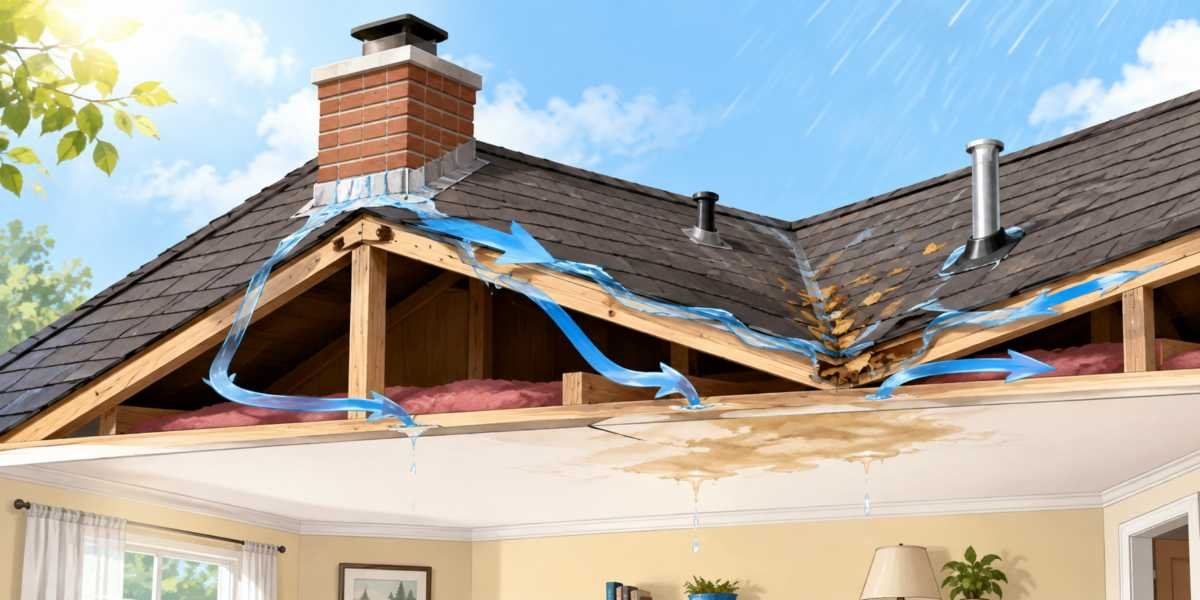
A roof leak can begin several feet away from the place where it finally becomes visible. Rainwater enters through a vulnerable point, encounters timber, insulation, membranes and other obstacles, and then follows whatever route gravity and the building’s construction provide. By the time it reaches the ceiling, it may have completed a surprisingly ambitious tour of the property.
Water Takes the Scenic Route
Once water gets beneath the outer roofing material, it doesn’t necessarily travel vertically downwards. It can run along rafters, roof decking, pipes and structural joints before finding somewhere to drip. Surface tension can even encourage water to cling to materials as it travels.This means the damp patch above the sofa might originate considerably farther up the roof. Fixing the area immediately above the stain could therefore accomplish little besides giving one innocent section of roof an unexpected renovation.
The direction of the roof slope provides an important clue. When investigating a leak, professionals will commonly work backwards and upwards from the visible damage, searching for possible entry points rather than assuming the obvious location is responsible.
Chimneys Have Plenty of Accomplices
Chimneys create particularly interesting opportunities for rainwater because they interrupt what would otherwise be a relatively continuous roof surface. Wherever two different structures meet, there is potential for deterioration or movement to create a route for moisture.The chimney itself may be perfectly sound while the materials surrounding it are responsible. Flashing is installed around chimney edges to direct water away from vulnerable joints. If flashing becomes loose, damaged, corroded or poorly sealed, rain can slip behind it and begin travelling underneath the roof covering.
Mortar joints and chimney crowns can also deteriorate over time. These problems deserve attention because repeated moisture penetration can gradually damage timber, insulation, plaster and other building materials. What begins as an occasional stain during particularly heavy rain can become a persistent structural maintenance problem if its source remains untreated.
Flashing Does an Unremarkable but Important Job
Nobody invites friends over to admire their flashing. It doesn’t feature prominently in estate-agent photographs, and homeowners rarely stand outside thinking, “That flashing really brings the whole property together.”Yet flashing performs some of the roof’s most important work. It protects transitions and joints around features such as chimneys, skylights, walls and vents where ordinary roofing materials cannot provide uninterrupted coverage.
A tiny opening in one of these areas can admit surprisingly large quantities of water during prolonged or wind-driven rain. Because the opening itself might be small and difficult to see, tracing the resulting leak requires examining how water could have moved after getting inside.
Roof Vents Can Create Unexpected Pathways
Modern roofs include a variety of vents to help manage airflow through attics and roof spaces. These vents are essential, but every opening in a roof also creates another location that depends on careful installation and ongoing maintenance.Rubber boots around plumbing vents can gradually crack after years of exposure to changing temperatures and sunlight. Fasteners may loosen, sealants may deteriorate, and flashing components may shift ever so slightly. None of these changes need to be dramatic before water begins finding opportunities to enter.
Because vent-related leaks often develop slowly, they can remain unnoticed until a period of particularly heavy rainfall finally exposes the problem. By then, the water may have travelled well away from the vent itself, leaving the visible damage to point accusingly at a completely innocent section of ceiling.
Roof Valleys Collect More Than Rainwater
Roof valleys deserve particular attention because they naturally channel large amounts of water. Whenever two roof slopes meet, they create a valley where rain is concentrated rather than dispersed.Leaves, twigs and other debris often collect in these areas, slowing the movement of water and increasing the amount of time moisture remains on the roof. During heavy storms, this can place additional pressure on joints and flashing. If maintenance has been neglected, even a relatively small weakness can become an entry point.
Valleys also tend to hide problems from casual inspection. From ground level everything may appear perfectly normal, while beneath accumulated debris a small defect quietly develops into a much larger repair.
Diagnosis Beats Guesswork Every Time
Successfully repairing a roof leak often depends less on replacing materials and more on identifying the true source. A visible stain is evidence that water arrived there, not proof that it entered there.Professional inspections typically involve looking beyond the obvious signs of damage. Roof condition, weather patterns, flashing details, penetrations, roof pitch and even wind direction during recent storms may all provide valuable clues. Taking the time to investigate thoroughly often prevents repeat repairs that solve only part of the problem.
Homeowners can also help by noting when leaks occur. Does the leak appear only during driving rain? Does it happen after snow begins melting? Does it require hours of rainfall before becoming visible? Small observations like these can narrow down possible causes considerably.
Raising the Roof Without Raising Repair Bills
Understanding how roof leaks behave makes it easier to appreciate why they sometimes seem so mysterious. Water follows the path of least resistance, not the path homeowners would prefer it to take. By the time it finally announces its arrival with a stain on the ceiling, its journey may have begun several feet away and involved rafters, flashing, valleys or vents along the way.Regular roof inspections, prompt maintenance and careful investigation remain far more effective than chasing visible symptoms alone. Solving the real source of the leak protects the building, avoids unnecessary repairs and helps prevent small defects from quietly growing into expensive surprises. A ceiling stain may get all the attention, but it is often just the messenger. Blaming it for the leak is a little like accusing the smoke alarm of starting the fire.
Article kindly provided by southjerseyroofrepair.com