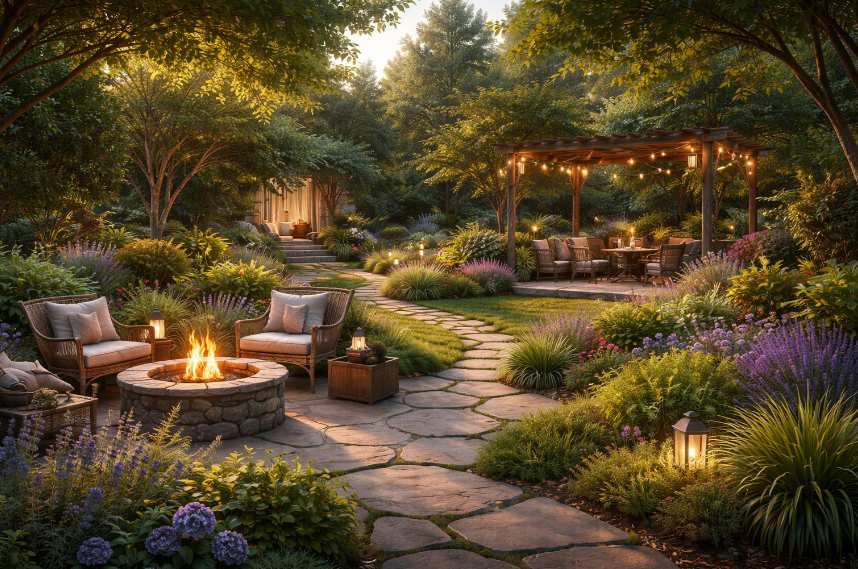
A well-thought-out outdoor space can lower stress, encourage conversation, or even help you focus better than your desk ever could. A poorly planned one tends to produce confusion, awkward movement, and that strange feeling of “I don’t know where to go, so I’ll just stand here holding a drink.” The difference isn’t luck. It’s psychology translated into layout.
Paths That Tell You What to Do Without Saying a Word
Movement shapes experience more than most people realize. When a yard lacks clear pathways, it creates hesitation. Guests slow down, second-guess where to step, and instinctively avoid exploring. That uncertainty adds friction, even if nobody can explain why.Defined paths remove that friction. They guide behavior quietly, almost invisibly. A curved walkway invites wandering, while a straight line suggests purpose and efficiency. Neither is better—they just serve different emotional outcomes.
- Curved paths encourage exploration and relaxation
- Straight paths create clarity and speed
- Stepping stones slow people down in a pleasant way
- Wide paths subtly invite social interaction
Invisible Walls That Make Spaces Feel Safe
Open space sounds appealing until you’re standing in the middle of it with no sense of direction. Without boundaries, a yard can feel exposed rather than freeing. This is where visual edges come in.Boundaries don’t need to be literal fences. They can be created with hedges, changes in elevation, or even a shift in materials. These subtle divisions give each area a purpose. A seating nook feels like a destination rather than a random arrangement of chairs that somehow wandered outside.
There’s a reason people gravitate toward corners in restaurants and cafes. Being partially enclosed reduces cognitive load. It signals safety. In a yard, the same principle applies. A bench tucked near a hedge feels more inviting than one placed in the center of an open lawn, where it doubles as a stage.
This doesn’t mean everything should be boxed in. The goal is balance—enough structure to feel grounded, enough openness to breathe. Too much enclosure starts to feel like you’ve accidentally built an outdoor hallway.
Zones That Match Your Intentions
A single-purpose yard rarely works because people rarely have a single purpose. Sometimes the goal is quiet reflection. Other times it’s hosting friends, working outside, or simply avoiding the indoors for a while. Trying to make one area serve all of those roles usually leads to compromise—and not the good kind.Dividing the space into zones creates clarity. Each area signals what it’s for, which reduces decision fatigue. You don’t have to think about where to go. You just go.
- A secluded corner for reading or thinking
- An open area for social gatherings
- A functional spot for tasks like gardening or working
- A transition space that connects everything together
Sometimes the only thing separating a peaceful retreat from a chaotic patch of grass is a few thoughtful decisions—and the willingness to admit that a folding chair in the middle of nowhere isn’t exactly a design strategy.
Seating That Changes Behavior Without You Noticing
Where you place a chair determines more than comfort—it influences how long someone stays, what they talk about, and whether they feel at ease. Seating that faces outward encourages quiet observation. Seating that faces inward invites conversation. Seating placed randomly tends to produce people checking their phones.Orientation matters just as much as location. A bench looking toward greenery promotes calm, while chairs arranged in a loose circle naturally pull people into interaction. If the goal is productivity, seating that provides a slight sense of enclosure—with a view but minimal distraction—helps the mind settle into focus.
Height and spacing also play subtle roles. Too far apart, and conversation becomes effort. Too close, and it feels like an accidental interview. There’s a sweet spot where interaction feels effortless, and it’s rarely achieved by guessing.
And then there’s the classic mistake: placing seating in the most visually obvious spot instead of the most comfortable one. Full sun at noon might look appealing for about seven minutes. After that, it becomes a lesson in regret.
Transitions That Smooth the Experience
Good outdoor spaces don’t jump abruptly from one function to another. They ease you from one state into the next. This is where transition areas—often overlooked—do their quiet work.A small change in material underfoot, a shift in lighting, or even a slight narrowing of a path can signal that you’re moving into a different kind of space. These cues help the brain adjust without conscious effort. Without them, the yard can feel disjointed, like flipping channels too quickly.
Transitions also prevent overcrowding. When everything connects seamlessly, people spread out naturally instead of clustering in one overused spot. That’s when a space begins to feel larger than it actually is.
There’s a practical upside too: smoother transitions reduce wear and tear. When movement flows logically, people stop inventing shortcuts—which, unfortunately, tend to run straight through whatever you were hoping to keep intact.
Lighting That Shapes Mood After Sunset
Once the sun sets, the psychology of a space shifts dramatically. Lighting becomes the primary influence on how the yard feels. Too bright, and it feels clinical. Too dim, and it feels like a guessing game with furniture.Layered lighting works best. A combination of soft ambient light, subtle pathway illumination, and focused accents creates depth and comfort. It allows people to see where they’re going without feeling like they’ve stepped into a parking lot.
Warm tones tend to promote relaxation, while cooler tones feel more alert and functional. Neither is inherently better, but mixing them without intention can create a slightly off atmosphere—like a room that can’t decide what it wants to be.
Placement matters just as much as brightness. Lighting from below adds drama, sometimes unintentionally. Lighting from above feels more natural. Somewhere in between is usually where people stop noticing the lights and start enjoying the space.
Grounds for a Better State of Mind
Designing an outdoor space isn’t really about plants, furniture, or materials. It’s about shaping behavior and emotion through physical cues. Every path, boundary, and seating choice sends a signal. Over time, those signals become habits—where you relax, where you think, where conversations unfold without effort.A thoughtful layout doesn’t demand attention. It quietly improves how the space feels and how people move through it. And when everything clicks, the yard stops being something you occasionally use and starts becoming somewhere you naturally gravitate toward.
That’s when design has done its job—not by impressing anyone, but by making the experience feel so intuitive that nobody questions it.
Article kindly provided by southjerseylandscapes.com